
How to See the Wind: A Complete Practical Guide
by adm.artemisclick- Uncategorized
- 30 abr
Seeing the wind is absolutely possible, and it doesn’t require expensive equipment or advanced technical knowledge. With free apps on your phone and animated maps available online, anyone can visualize wind direction, intensity, and air behavior in real time, anywhere on the planet.
For surfers, kiteboarders, or anyone planning an outdoor activity, understanding the wind makes all the difference. Knowing where it’s coming from, how strong it’s blowing, and how it moves over the ocean or your city can completely change your plans for the day.
In this guide, you’ll discover the top tools for visualizing the wind, understand how they work, and learn how to get the most out of them in everyday life. From the most popular platforms among surfers to the technologies NASA uses to make air visible, this content covers everything you need to know.
What is wind visualization and how does it work?
Wind visualization is the set of techniques and tools that translate invisible atmospheric data into images humans can understand. Since moving air has no color or visible form, scientists, meteorologists, and developers have created ways to represent it graphically — through animated maps or advanced optical technologies.
In practice, wind maps work by collecting data from weather stations, satellites, and numerical forecast models. That data is processed and turned into animations showing wind paths using arrows, streamlines, or moving particles. The higher the wind speed, the faster and more intense the movement appears on screen.
This visualization serves purposes far beyond curiosity. Pilots, sailors, surfers, farmers, and wind energy engineers rely on this information to make safe and efficient decisions. Understanding wind behavior is, in many cases, a matter of safety.
Why is wind invisible to the naked eye?
Wind is the movement of air masses, and air is made up of transparent, very small gas molecules. Because these molecules don’t absorb or reflect visible light in a way the human eye can detect, moving air simply doesn’t appear visually under normal conditions.
What we see as the effects of wind are actually the objects it pushes or carries: leaves flying, waves forming, flags flapping. The wind itself remains invisible because it has no surface, color, or density sufficient to interact with light in a way our eyes can pick up.
This changes in specific situations. When the air is loaded with particles — such as dust, smoke, or haze — the movement becomes more apparent. That’s why on beaches with fine sand and strong wind, you can literally see the wind blowing low across the ground, carrying grains along with it.
What technologies make the wind visible?
The main technologies used to visualize wind fall into two groups: capture and representation.
In the capture group are physical instruments such as anemometers (which measure speed), wind vanes (which indicate direction), automated weather stations, and atmospheric observation satellites. These devices collect the raw data that feeds visualization systems.
In the representation group are meteorological modeling software and visualization platforms such as Windy, Ventusky, and Earth Nullschool. They take the collected data and create real-time animations, showing the wind as moving particles or streamlines over geographic maps.
A third, more specialized category involves optical techniques used in laboratories and by agencies like NASA. The schlieren technique, for example, can capture air density variations and make them visible in high-precision images. This approach is used primarily in scientific research and aeronautical engineering.
What are the best apps to see the wind?
There are several reliable apps for tracking the wind in real time, both on your phone and on your computer. The most widely used by surfers, kiteboarders, and nautical professionals are Windfinder, Ventusky, and Windy. Each has its own characteristics that make it better suited for different contexts.
The best app depends on what you want to do. If the priority is tracking local conditions for surfing or kiting, Windfinder is very accurate for specific coastal spots. If you want a panoramic and visually stunning view of global atmospheric patterns, Windy and Ventusky stand out.
- Windfinder: focused on water sports and wind sports
- Ventusky: map visualization with multiple atmospheric layers
- Windy: rich interface with data from multiple weather models
- Windguru: very popular among surfers and windsurfers
- Weather Underground: strong network of personal weather stations around the world
All have functional free versions. Some offer paid plans with more detailed data, history, and custom alerts.
How do you use Windfinder to track the wind in real time?
Windfinder is one of the most popular tools among surfers and wind sports enthusiasts. To use it, simply visit the website or download the app, search for your city or beach, and select the desired spot on the map.
The main screen shows an hourly forecast table that includes wind speed, gusts, direction, water temperature, wave height, and weather conditions. The information is updated frequently and comes from global weather models combined with data from local stations.
A very useful feature is SuperForecast, available for locations with a denser network of stations. It offers forecasts at one-hour intervals with greater local accuracy. For anyone who wants to know what the wind is like today before heading to the beach, Windfinder delivers a fast and reliable answer.
How does Ventusky work for visualizing wind on the map?
Ventusky is a meteorological visualization platform that turns atmospheric data into colorful, fluid animations over an interactive map. When you open the site, you immediately see particles moving across the globe, representing wind direction and speed at the selected atmospheric layer.
You can switch between different climate variables: wind at various altitudes, temperature, precipitation, atmospheric pressure, and more. To understand wind behavior in a specific region, simply zoom in on the map and click the desired point to see exact values.
Ventusky’s biggest advantage is its layered visualization. You can see how the wind behaves at different altitudes simultaneously, which is especially useful for understanding phenomena like cold fronts, high-pressure zones, and the formation of ocean swells related to swell.
What is Windy and how does it show air movement?
Windy is arguably the most complete weather app available to the general public. It combines data from several forecast models — including the European ECMWF and the American GFS — and presents everything in a highly polished visual interface.
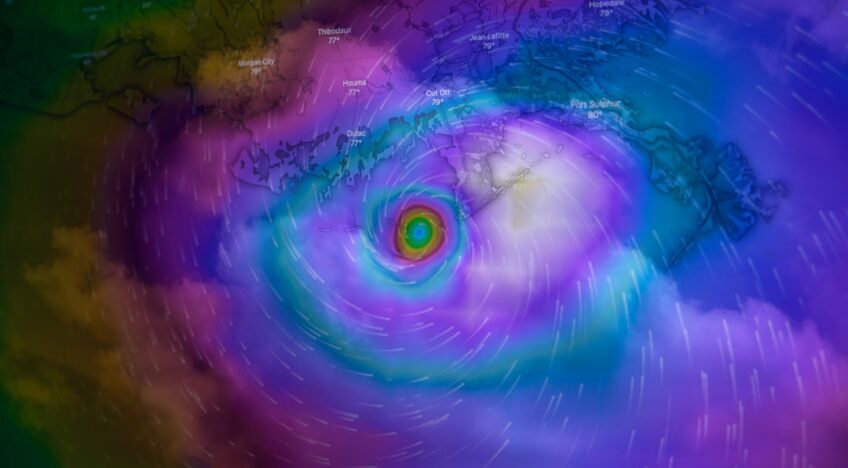
Windy’s wind visualization uses animated particles that follow airflow across the map. The faster the particles, the higher the wind speed. Colors also help: green and blue tones indicate lighter winds, while yellow, orange, and red signal strong to very strong winds.
In addition to surface wind, Windy lets you visualize winds at altitude, which is valuable for understanding where the systems influencing local conditions originate. For surfers who want to understand how wind affects wave formation and wind direction relative to the break, Windy is an extremely comprehensive tool.
How can you see the wind on a free online map?
Viewing the wind on an online map is free and accessible to anyone with an internet connection. The main platforms don’t require registration for basic use and work well on both computers and mobile devices.
Beyond the apps already mentioned, there are tools specifically designed for global wind visualization, with a focus on visual beauty and scientific clarity. Earth Nullschool is the best-known example in this category, widely shared on social media for the stunning visuals it produces.
For tracking wind with a focus on surf and coastal conditions, combining two or three different apps is a good practice. Each platform uses distinct weather models, and comparing forecasts increases reading reliability, especially on days with unstable conditions.
Does Earth Nullschool show global winds in real time?
Yes. Earth Nullschool, accessible at earth.nullschool.net, is one of the most visually striking tools for seeing wind across the entire world. It displays an animated globe with moving particles representing winds in real time or in forecast mode.
The data comes from public weather models updated every few hours. This means the visualization isn’t a live stream of the current second, but it very accurately reflects recent atmospheric conditions and the forecast for the coming hours.
One of the most interesting features is the ability to change the observation altitude. You can view wind at the surface, in the troposphere, in the stratosphere, and even higher layers. You can also switch to other variables, such as ocean temperatures and sea currents, which is very useful for understanding how tides work and ocean systems in a broader context.
How do you interpret wind animations on these maps?
Interpreting wind animations is simpler than it seems. The main elements are the direction of particle movement, speed, and the color scale used by the platform.
Direction is indicated by which way the particles or arrows are moving. In the Northern Hemisphere, winds from the north typically bring cold air, while winds from the south generally bring warmth and humidity. For surfing, direction is crucial for determining whether the wind is offshore (favorable) or onshore (unfavorable).
Speed appears in two ways: by how fast the particles move in the animation and by the map’s color scheme. Cool tones (blue, green) indicate light winds, while warm tones (orange, red) signal strong winds. Click or tap any point on the map to see exact numerical values in knots, km/h, or m/s.
For those who want to deepen their reading of ocean conditions, understanding wind alongside information about swell in surfing is the natural next step.
How does NASA photograph and visualize the wind?
NASA has developed advanced methods for making air visible in images — going far beyond what conventional weather apps can show. These techniques are used primarily in aerospace research, aircraft development, and the study of atmospheric phenomena at very small scales.
The goal isn’t just to display wind on climate maps, but to precisely visualize how air behaves around objects such as airplane wings, rockets, or vehicles at high speed. To do this, the agency uses optical technologies that detect subtle variations in air density, making shock waves, turbulence, and aerodynamic flows completely visible.
What is the schlieren technique and how does it visualize air?
The schlieren technique is an optical method that makes density variations visible in transparent fluids, including air. When air moves at different speeds or temperatures, its density changes. These changes slightly affect the way light passes through the air, and the schlieren technique captures exactly that.
The classic system works with an intense light source, precision mirrors or lenses, and a camera. Light passes through the study field, and any density variation deflects light rays in ways imperceptible to the naked eye but detectable by the optical system. The result is a black-and-white image that clearly reveals airflows, turbulence, and pressure waves.
This technique has been used for decades in aeronautical laboratories. What NASA did was modernize it and scale it for use in outdoor environments and at greater scales, without needing vacuum chambers or complex fixed structures.
How did NASA’s camera replace the traditional schlieren system?
The traditional schlieren system requires a very precise physical setup and normally works only in a laboratory. NASA developed a version called Background-Oriented Schlieren (BOS), which uses high-resolution cameras and a patterned background (such as a dotted panel) to detect the same density variations without needing complex mirrors and lenses.
With this approach, it’s possible to photograph the air around aircraft in actual flight — something the classic method would never have allowed. The camera captures two images: a reference image with no disturbance and one with the object in motion. Software then compares the two and calculates where and how light was deflected, generating images that show shock waves and airflows in impressive detail.
This innovation opened new possibilities for studying aerodynamic behavior under real operating conditions. For the field of meteorology and wind visualization at a larger scale, these principles inspired the development of specialized sensors and cameras used in satellites and observation stations.
How can you see wind direction and speed in your area?
To see wind direction and speed in your area, the most practical tools are weather apps with local coverage. Platforms like Windfinder, Windy, and Windguru let you search for any city or geographic point and return frequently updated data.
Wind direction is presented in degrees (0 to 360°) or by cardinal points. A north wind, for example, is one that blows from north to south. Speed is typically shown in knots (kt), kilometers per hour (km/h), or meters per second (m/s), depending on the platform.
For those who live in a coastal area or practice outdoor sports, understanding what the prevailing wind is at a location throughout the year is just as important as tracking daily conditions. This allows you to plan activities much further in advance and with greater safety.
Can you see the wind on your phone in real time?
Yes, and it’s very simple. The top wind apps have versions for both Android and iOS that work great with GPS data for automatic location. When you open the app, it already detects where you are and shows current conditions along with the forecast for the next several hours and days.
Windy, for example, has a robust app that works offline for already-downloaded forecasts, which is useful in areas with poor connectivity, such as remote beaches. Windfinder has a streamlined interface specifically designed for quick use before heading into the water.
For an even more accurate reading, some surfers and kiteboarders use portable anemometers that connect to their phones via Bluetooth. These devices measure the wind at your exact location and send the data to a dedicated app. It’s a more technical solution, but very effective for those who rely on this information regularly. If you’d like to learn more about how to measure the wind accurately, that topic is worth exploring further.
Which weather sources are most accurate for checking the wind?
The accuracy of wind forecasts depends on the weather model used, the density of data collection stations in the region, and the spatial resolution of the data. In general, the most respected models are the ECMWF (European), the GFS (American), and the ICON (German).
The ECMWF is generally considered the most accurate globally, especially for medium-range forecasts. The GFS has good resolution and is publicly accessible, which is why it’s widely used by free platforms. For local and short-range forecasts, high-resolution models like AROME (European) and NAM (American) tend to perform better.
For the United States, the National Weather Service (NWS) and NOAA are reliable official sources. Combining them with international platforms like Windy, which aggregates multiple models, is the best strategy for a more reliable wind reading in your area.
How is tracking the wind useful in everyday life?
Monitoring the wind is no longer exclusive to meteorologists and maritime professionals. Today, anyone who practices outdoor activities, plans open-air events, or simply wants to dress appropriately for the day has concrete benefits from tracking the wind.
In urban settings, strong winds affect thermal comfort, building safety, and even traffic during storms. On the coast, wind is one of the most determining factors for wave quality, water safety, and conditions for sports like surfing, kiteboarding, windsurfing, and stand-up paddleboarding.
Knowing how to read a wind map gives you an advantage — whether to choose the best day to surf, to decide if you’ll go paragliding, or simply to know if it’s worth opening your windows at home.
Who else benefits from tracking wind online?
Beyond water and air sports enthusiasts, many other groups depend on accurate wind information in their daily lives.
- Farmers: wind influences the application of pesticides, irrigation, and crop protection
- Sailors and fishermen: wind conditions determine safety and route planning at sea
- Wind energy engineers: they map the wind potential of regions to install turbines
- Firefighters and wildfire crews: wind is a critical factor in the spread of wildfires
- Architects and builders: they factor in prevailing winds when designing structures
- Runners and cyclists: they adjust routes and pace based on wind direction and intensity
For anyone on a coastal stretch of the US or elsewhere, combining wind readings with tide and swell information creates a complete picture for assessing ocean conditions with much greater precision.
How do surfers and kiteboarders use wind maps?
For surfers, the ideal wind is offshore — blowing from land to sea. This type of wind organizes the waves, creates clean walls, and greatly improves surf quality. Onshore wind, blowing from sea to land, chops up the waves and makes surfing more difficult. Knowing how to identify this difference on maps is a basic skill for any surfer who checks conditions before heading to the beach.
For kiteboarders and windsurfers, the reasoning is different. They need consistent wind with enough intensity to sustain the kite or sail. Direction matters for determining a safe riding area, avoiding winds that could push the rider toward shore or into hazardous zones.
On wind maps, surfers look for offshore windows in the early morning hours, before land breezes give way to the sea breeze. Kiteboarders prefer the afternoons, when the sea breeze arrives stronger and more consistent. To better understand how swell and waves relate to wind, that combined reading makes all the difference in choosing the best moment to get in the water.